

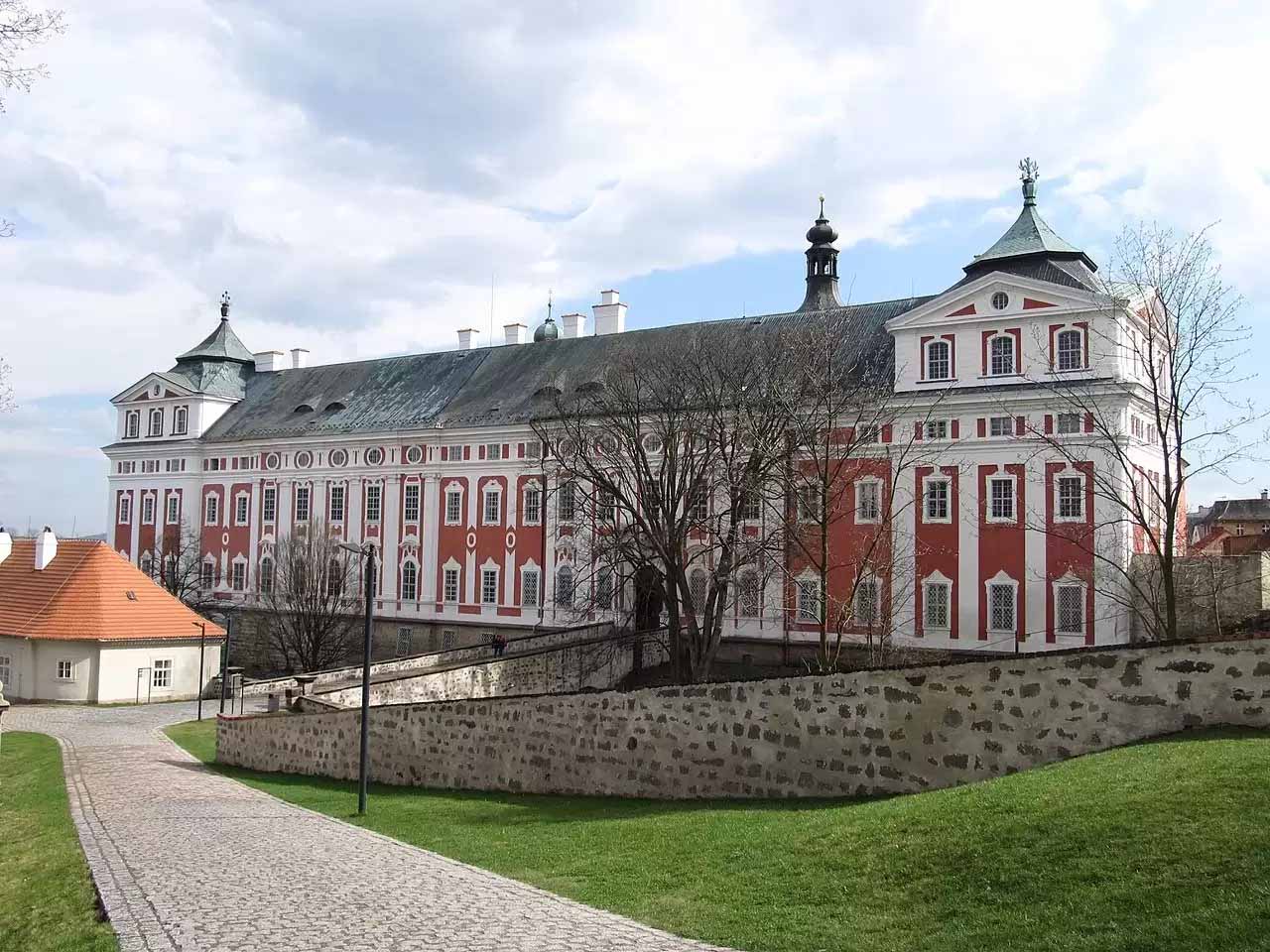
Broumov Monastery
Accommodation at Villa Marcelka in Broumov, near the Broumov Monastery. Enjoy comfort and tranquility in a charming villa with modern amenities – ideal for families and couples. A perfect base for discovering the beauty of the Broumov region and its surroundings.
The Benedictine Order was founded in the 14th century. The building was rebuilt in the early 18th century in the Baroque style by Christoph Dientzenhofer and his son Kilian Ignaz. Due to its architectural and cultural value, it has been listed as a national cultural monument of the Czech Republic since 1995.
History
Broumov Monastery, with the originally Gothic Church of St. Adalbert, was established in the mid-13th century on the site of a former castle. In the early 13th century, Benedictine monks from the Monastery of St. Adalbert and later St. Margaret in Břevnov were granted land in the area around present-day Police nad Metují by King Přemysl Otakar I. The monastery itself was founded after 1258 as a priory under the authority of the parent monastery in Břevnov.
The significance of Broumov grew considerably during the Hussite Wars. After the Břevnov Monastery was burned down by the Hussites in 1420, Abbot Nicholas II and several monks fled to the fortified town of Broumov, bringing with them many valuable items such as the church treasure, the library, and the world’s largest manuscript – the Codex Gigas, which has been held in Sweden since 1648 as war booty. The move of the Břevnov abbots to Broumov marked a significant boost in the cultural and economic development of the town and region. From that point on, the abbot bore the title "Abbot of Břevnov in Broumov," later "Abbot of Břevnov-Broumov."
Broumov Monastery and the Church of St. Adalbert
In 1559, the priory building and the town were destroyed by fire. By the end of the 16th century, the monastic life had declined due to the influence of the Reformation.
During the Catholic Counter-Reformation after 1620, the monastery experienced a revival. In 1624, a grammar school was founded. Important abbots like Thomas Sartorius, Otmar Zinke, and Benno Löbl returned the monastic seat to Břevnov. Near the end of the Thirty Years' War, the monastery was plundered by the Swedes and later seriously damaged by fire.
This period gave rise to remarkable construction, artistic, and musical activity. Under Abbot Sartorius, the monastery church was rebuilt between 1663 and 1669 from a Gothic basilica into a Baroque single-nave structure with side chapels by Italian builder Martin Allio von Löwenthal. Abbot Zinke commissioned renowned Baroque architects Christoph and Kilian Ignaz Dientzenhofer to remodel the convent and prelature between 1727–1733. After two fires in the late 18th century, the building was restored with slight modifications. At that time, the Benedictines reached a strong economic position through business ventures and organizing linen production among hundreds of home weavers – enabling them to finance ambitious monastery construction projects, including the so-called Broumov group of churches.
Kilian Ignaz Dientzenhofer also designed the interior, executed by leading Prague Baroque artists – stucco artist Bernardo Spinetti, fresco painter Johann Karl Kovář, and painter Felix Antonín Scheffler. The abbey and convent interiors were decorated with paintings by Peter Brandl. Altar paintings in the side chapels were made by Václav Vavřinec Reiner.
After World War II, Broumov’s German population was expelled (two monks were murdered while serving as parish priests). They resettled in Rohr, Bavaria. In 1946, Czech-American Benedictines from St. Procopius Abbey in Lisle near Chicago attempted to establish a new community. However, in 1948 the communist regime expelled them from Czechoslovakia.
In 1950, the monastery was converted into an internment camp for religious orders. Later, nuns from various congregations were confined here. Living conditions were harsh, and they were forced to work in factories and agriculture. After 1968, the political situation relaxed slightly, and the nuns could work in nursing homes. Since 1974, the main monastery building housed the Central Archive for storing restricted state documents. In 1980, a reconstruction project began but was never completed. A small group of Dominican nuns remained in Broumov, baking communion wafers for churches in Bohemia and Moravia. In 1990, they moved to women's monasteries in Moravia.
Monastic School
The famous monastery library
The Benedictine monastic school was well-known even before the Hussite Wars. Its prominent graduates include Prague's first archbishop, Arnošt of Pardubice. In 1624, the school became a grammar school. Its graduates include Prague Archbishop Matthias Ferdinand Sobek von Bilenberg, historian Bohuslav Balbín, patriotic priest Josef Regner Havlovický, and writer Alois Jirásek (from nearby Hronov). Alois Rašín, the first finance minister of Czechoslovakia, also studied here. The school was closed by the Nazis in 1939.
Valuable Exhibits
-
The library, with about 17,000 volumes, is one of the few preserved monastic libraries in the Czech Republic. Thousands of books – mostly from the grammar school library – were destroyed under the communist regime.
-
A copy of the Shroud of Turin from 1651 was discovered in 1999 in the church room above the Chapel of the Holy Cross. It was a gift from Turin Archbishop Julius Caesar Barbera to Prague Archbishop Matthias Ferdinand Sobek, who donated it to Broumov Monastery. Only about 40 copies exist worldwide – the Broumov copy is the only one in Central Europe.
-
The Vamberk mummies – 34 in total – were transferred from the crypt of the parish church in Vamberk in 2000 due to unsuitable storage conditions. They include important citizens from the 18th century, such as Countess Magdalena Grambová, founder of the Vamberk lace industry.
Monastery Garden
The garden was founded around 1676 by Abbot Sartorius. Its front section is a Baroque ornamental garden in the Italian style, with geometric patterns. The rear section originally served as a utility garden and later became a landscaped park with a Baroque fountain. Covering about 2.5 hectares, the garden is part of the national cultural heritage. In 2014, it was fully revitalized, including the gardener’s house, gallery house, fountain, wood shed, historic bowling alley, water tower, and the monument to Abbot Jakob Chmel. Today it has the character of an English park with views of the Javoří Mountains. Open daily – May to October: 8 a.m. to 8 p.m.; November to April: 8 a.m. to 6 p.m.
Curiosities
-
Abbot Thomas Sartorius funded the 24th chapel of the pilgrimage route from Prague to Stará Boleslav. The chapels were built by Jesuits between 1674–1690.
-
Writer Josef Škvorecký briefly stayed at the monastery in the winter of 1950 and described the experience in his short story The Laws of the Jungle.
Present Day
In 1990, the Benedictines of Břevnov regained the monastery through restitution. Renovations were carried out first at Břevnov, then at Broumov. Today, the Broumov Region Museum is located on the first floor of the prelature. The parish is now administered by the Premonstratensians from Želiv, though Benedictine brother Gereon also served here briefly.
Since the early 21st century, no members of the Benedictine Order live in the monastery. It is still managed from Břevnov (the current administrator is Prokop Siostrzonek). The monastery is part of the Czech Republic’s architectural heritage preservation program. After its revitalization in 2014, the monastery is open year-round, offering guided tours and a café (Café Dientzenhofer). It houses the Broumov Monastery Educational and Cultural Center, hosting concerts, lectures, Science Café events, senior university programs, exhibitions, and more.
Kontakt
Ubytování Broumov - Vila Marcelka
Broumov - Benešov 40, 550 01
tel.: +420 734 405 063
email.:
IČO: 19267576
Menu
Booking